Practise the art of good conversation
A card game that helps a group learn and practise the four voices of a healthy conversation — while working on a real task together.
Most conversations don’t get stuck because someone is difficult. They get stuck because a way of contributing goes missing. Everyone keeps proposing and no one commits. Everyone agrees and no one questions. Two people go back and forth and no one steps back to notice it.
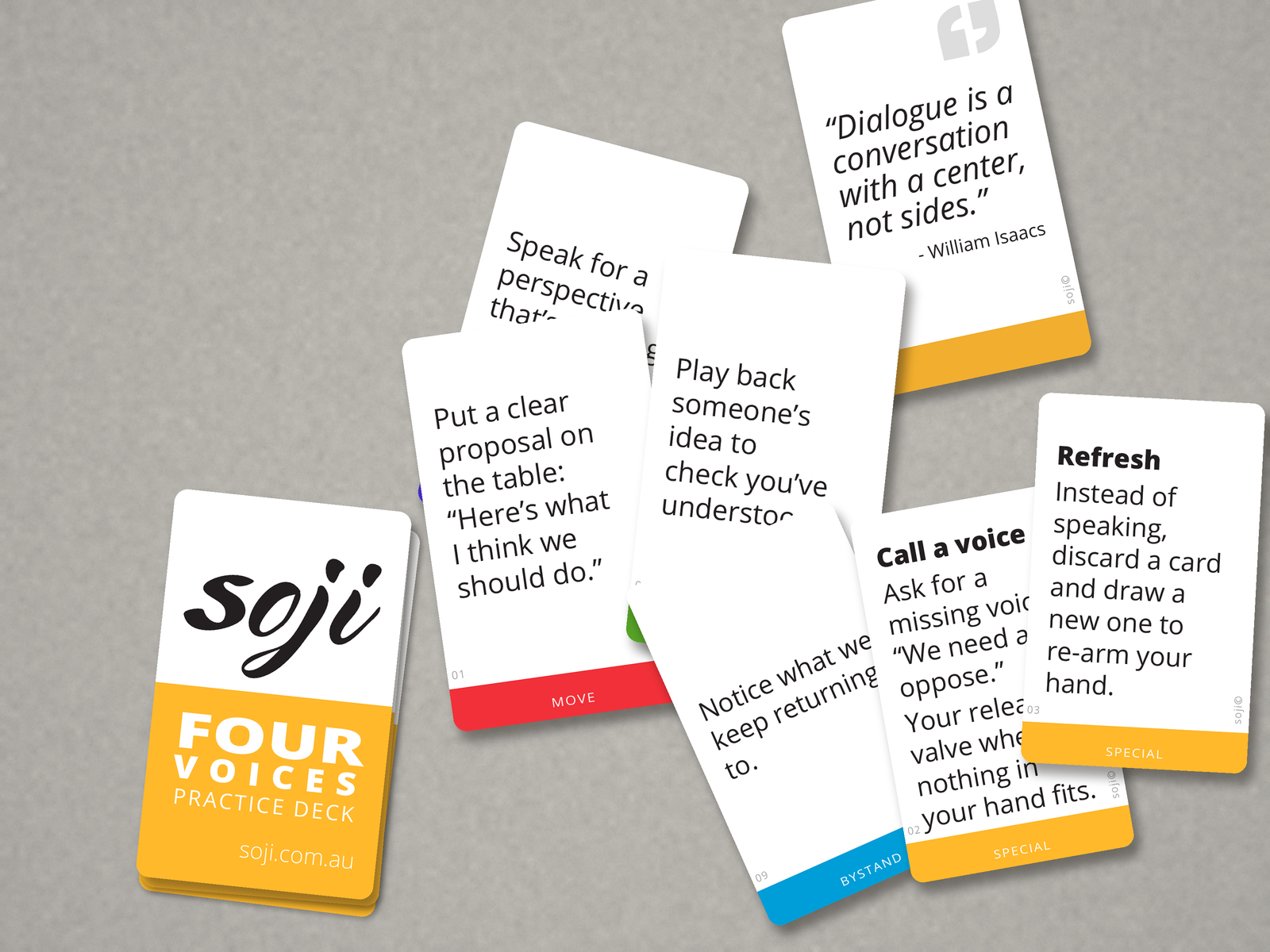
Four Voices is a simple deck that makes those patterns visible and gives people a low-pressure way to practise the moves they don’t reach for naturally. You deal a hand, put a task on the table, and play cards to shape the conversation — spending them and drawing new ones as you go. It works as a warm-up, a team workshop, or a scaffold for a real decision your team needs to make.
The four voices
Every conversation is built from four kinds of contribution. Healthy groups move fluidly between all four; stuck groups get caught missing one or two. No voice is better than another, and everyone can learn to use all of them.
- Move — set a direction and put something new on the table.
- Follow — support, build on and complete what others begin.
- Oppose — challenge, question and protect what matters.
- Bystand — notice the pattern and offer perspective.
The four voices come from David Kantor’s Four-Player Model, part of his work on Structural Dynamics — a well-established way of understanding how conversations actually move.
How to play
One simple base game, then a menu of variations. It works for two to six players and takes as little as fifteen minutes.
Base game: spend your hand
Set up. Shuffle the four voice suits into one draw pile. Set the task and special cards aside. Deal each player a hand of four or five cards. Turn over a task card, or agree a real task to work on.
Play. Talk about the task like a normal conversation, with one rule: to speak, play a card from your hand that matches the kind of contribution you’re about to make — then actually make it. Lay the card down, make your move, follow, oppose or bystand for real, and draw a replacement.
The stretch. You can wait for the right card, or play one you’re holding and shape your contribution to fit it. Playing to your hand is what nudges you into the voices you’d normally skip.
Ending. A round ends when the group reaches a decision, when a timer runs out, or when the first player empties their hand. There are no winners — the point is the conversation.
Playing with two to six
- Two. Deal hands of four and work a real task in clear turns. With only two people the bystand is harder, so every few exchanges, one of you plays a bystand about the two of you. A strong format for a coaching pair or a manager and report.
- Three or four. The sweet spot. Deal hands of four or five and let it flow — no facilitator needed once people know the rule.
- Five or six. Deal hands of five and ask one person to facilitate rather than hold cards. They keep the pace, call the pauses, and run the debrief. Give each contribution a loose thirty to forty-five seconds so the conversation doesn’t sprawl.
When none of your cards fit
The cards are a scaffold, not a gate. You can always say what the conversation needs — and the moment your hand has nothing for it is a signal to read, not a wall to hit. It usually means you, or the group, is stuck in one voice. You have three honest options:
- Play a bystand. You can nearly always name what’s missing. “We’ve had five ideas and no one’s decided” is a bystand that also calls for the move the room needs.
- Refresh. Instead of speaking, discard a card and draw a new one. A healthy way to say, “I don’t have the right thing to add right now — let me listen.”
- Stretch. Reach your point through a different voice. Wanted to propose something but only hold follows? Build on someone else’s idea toward your point instead.
Play strictly by the cards while you’re learning, and loosen as the group matures. For an experienced team, the cards eventually come off and they simply talk better.
Variations
Add these once the base game is familiar. Each one teaches something specific.
- Voice focus. Deal one player a hand of a single voice for a round. It surfaces how it feels to hold that voice — and how the group responds.
- Call a voice. Anyone may call for a missing contribution: “We need an oppose here.” It teaches the skill of spotting the gap.
- Break the pattern. When the group gets stuck, a Freeze card stops play. Name the pattern, then play the missing voice to get moving again.
- Trade and refresh. Let players swap cards or redraw — it quietly reveals who leans on which voice.
- Real-task mode. Once the mechanics are second nature, drop a genuine team decision on the table and let the game run as a real working meeting with the scaffold underneath.
Getting the most from it
The game creates the experience; the conversation afterwards is where the learning lands. Leave a few minutes to reflect together:
- Which voice felt easy for you, and which felt like a stretch?
- What happened when a voice went missing?
- Which voice does this team reach for most, and which does it under-use?
- What would you like to practise more of in a real meeting this week?
The shared language tends to travel back into everyday work on its own — “we were stuck in back-and-forth until someone bystood.”
“Dialogue is a conversation with a center, not sides.”
— William Isaacs, Dialogue: The Art of Thinking Together
Four Voices is made by Soji Learning and Change, Adelaide. Based on the Four-Player Model developed by David Kantor. Shared for personal and professional development.
© 2026 Soji Learning and Change · soji.com.au