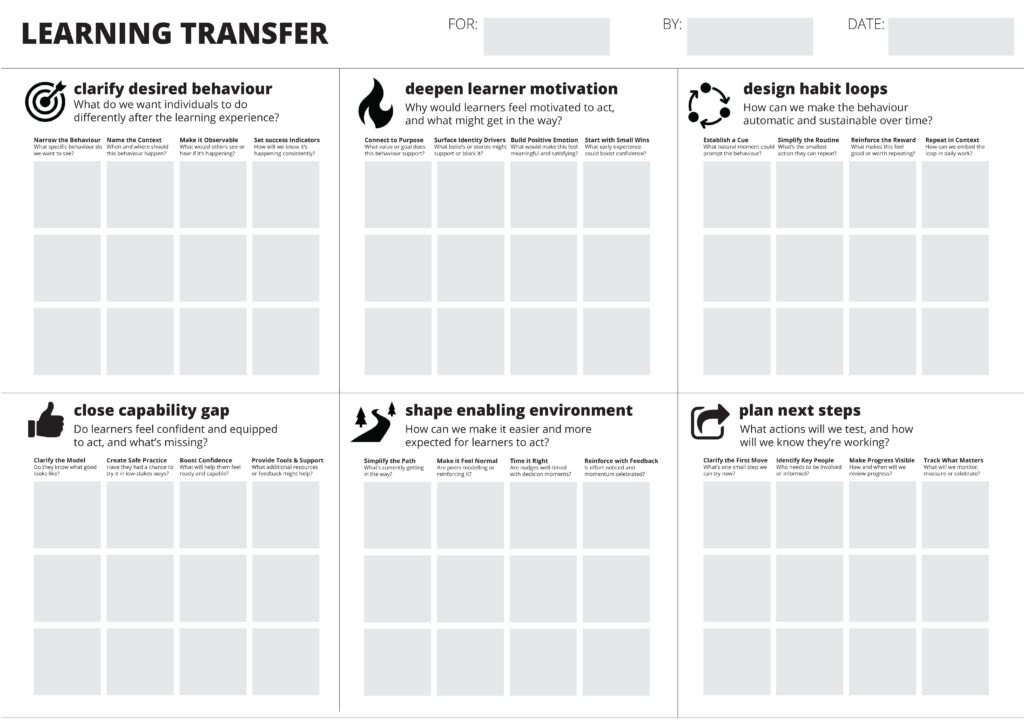


The Learning Transfer Canvas for Behaviour Change
A field-ready tool for turning training into observable workplace behaviour.
Many learning and change programs are designed with good intent, strong content, engaging facilitation, and people eager to improve. Yet weeks later, the intended behaviour shift often hasn’t taken root in day-to-day work. That doesn’t mean the program was bad. More often, it means transfer wasn’t built into the system. It was seen as a possible afterthought, not deliberately embedded in practice.
The Learning Transfer Canvas is a scaffold for learning, HR, OD, and change practitioners. It helps them design or review programs that create conditions for new behaviours to transfer into practice. This is especially important in leadership, culture, and change settings where workload, ambiguity, emotion, and competing priorities are real.
To make this immediately usable, here’s the framing we’ll use:
Imagine you’re about to launch a skills program to improve meeting practices. Before you finalise content or scheduling, your design team conducts a short Learning Transfer review. You choose one tangible behavioural shift that the program aims to achieve. Then use the canvas prompts to surface what needs to be designed into the program and workplace so the behaviour shows up reliably.
And to keep it vivid, we’ll use the following example behavioural shift:
Target behaviour example: In weekly team meetings, leaders run a 5‑minute “Progress + Blockers + Next Move” routine to reinforce the new way of working.
You can swap in any behaviour your program is aiming to change. The canvas and this article will still work.
How to use the Learning Transfer Canvas
Select a target behavioural shift and explore it as you work through the canvas. Record responses on sticky notes, one idea per note. If in a group, reflect individually first, group themes, then pick the top 1–2 design improvements to test.
1. Clarify the Behaviour
- Narrow the Behaviour — What specific behaviour do we want to see?
- Name the Context — When and where should this behaviour happen?
- Make it Observable — What would others see or hear if it’s happening?
- Set success Indicators — How will we know it’s happening consistently?
How to apply this:
This is where transfer becomes designable. Many programs start with topics (“culture”, “change leadership”, “performance conversations”) and assume the right behaviours will follow. The canvas flips that: it insists on one behaviour in one context, in a form that can be observed.
Using our behaviour example, “Progress + Blockers + Next Move” becomes specific when you define:
- the moment (weekly team meetings),
- the duration (5 minutes),
- the observable moves (leaders ask for progress; surface blockers; agree on the next move),
- and the consistency signal (it happens every week, not occasionally).
2. Deepen Learner Motivation
- Connect to Purpose — What value or goal does this behaviour support?
- Surface Identity Drivers — What beliefs or stories might support or block it?
- Build Positive Emotion — What would make this feel meaningful and satisfying?
- Start with Small Wins — What early experience could boost confidence?
How to apply this:
This step is about designing the internal conditions for follow‑through. In real workplaces, people don’t sustain behaviours that feel pointless, risky, or misaligned with identity.
For “Progress + Blockers + Next Move,” motivation will be stronger when leaders can connect the routine to a purpose they value. Examples include clarity, momentum, fewer surprises, and better delivery. Motivation grows when the routine fits a leadership identity they can own. For instance, “I create focus and movement,” rather than “I just report status.”
Identity drivers signal resistance. A leader thinking “meetings are a waste of time” will rush or skip the routine. One focused on “appearing in control” may dodge naming blockers. Your design can ignore or tackle these stories.
Positive emotions and small wins matter because they build early reinforcement. If the first few runs of the routine build visible momentum—for example, a blocker is removed or a next move is clarified—the behaviour earns its place in the meeting. If it feels awkward or bureaucratic, it will fade, even if everyone agreed it was a good idea.
3. Design habit loops
- Establish a Cue — What natural moment could prompt the behaviour?
- Simplify the Routine — What’s the smallest action they can repeat?
- Reinforce the Reward — What makes this feel good or worth repeating?
- Repeat in Context — How can we embed the loop in daily work?
How to apply this:
This section is where “transfer” stops being hope and becomes architecture. If the behaviour relies on memory and willpower, it won’t last. Habit design makes it more automatic.
- Cue is already built in: the weekly meeting.
- Routine is intentionally small: five minutes, three prompts.
- Reward must be immediate and felt: clearer priorities, visible movement, reduced friction.
- Repeat in context is critical: is it embedded in the meeting agenda template, team norms, leader prompts, and facilitation scripts, or left as a good intention?
4. Close the capability gap
- Clarify the Model — Do they know what good looks like?
- Create Safe Practice — Have they had a chance to try it in low-stakes ways?
- Boost Confidence — What will help them feel ready and capable?
- Provide Tools & Support — What additional resources or feedback might help?
How to apply this:
Even a simple routine like “Progress + Blockers + Next Move” can fail if leaders don’t know what “good” looks like in practice. For example, how do you surface blockers without creating blame? How do you keep it tight to five minutes? How do you turn blockers into actions rather than complaints?
- a clear model (what good facilitation looks and sounds like),
- low‑stakes rehearsal (practice in a safe setting before doing it with real teams),
- confidence-building supports (simple structure, timeboxing, language cues),
- and tools (agenda template, prompt card, a short checklist, and feedback loops).
5. Shape enabling environment
- Simplify the Path — What’s currently getting in the way?
- Make it Feel Normal — Are peers modelling or reinforcing it?
- Time it Right — Are nudges well-timed with decision moments?
- Reinforce with Feedback — Is effort noticed and momentum celebrated?
How to apply this:
The environment is often the silent determinant of transfer. Even motivated and capable leaders revert when the system rewards old behaviours. Examples include urgency over reflection, reporting over problem-solving, or perfection over learning.
- meeting agendas are already overloaded (path friction),
- leaders don’t see peers doing it (not normal),
- prompts aren’t present when agendas are built (nudges poorly timed),
- and no one acknowledges leaders who hold the routine consistently (no reinforcement).
6. Plan next steps
- Clarify the First Move — What’s one small step we can try now?
- Identify Key People — Who needs to be involved or informed?
- Make Progress Visible — How and when will we review progress?
- Track What Matters — What will we monitor, measure or celebrate?
How to apply this:
Make this canvas practical. Choose the 1–2 design changes that will most improve transfer and test them.
- piloting the routine in two teams for four weeks,
- embedding the prompts into the agenda template and leader checklist,
- and building a simple review rhythm (e.g., fortnightly check‑in where leaders share what shifted, what blockers surfaced, what next moves became clearer).
Make transfer a design standard
If you want learning to change behaviour, don’t rely on hope. Design the conditions that make the behaviour likely: clarity, motivation, habits, capability, environment, and next steps.
Use the Learning Transfer Canvas as a pre‑launch (or mid‑stream) design review tool. Choose one behavioural shift your program must achieve, work through the prompts, and implement 1–2 high‑leverage improvements that strengthen the conditions for transfer.
If you’re ready to strengthen a program you care about, download the Learning Transfer Canvas here and run a short review—solo or with stakeholders using sticky notes.
We hope these resources are as helpful for you as they have been for us. At Soji, we’ve found that effective change is less about a one-size-fits-all solution and more about having the right tools to develop and refine your practice.
To work with us on behaviour change and leadership development, reach out to us at info@soji.com.au.